
Strip and wax for VCT and vinyl
Full removal of old finish, neutralising, then four to six coats of commercial floor finish with proper cure time between coats. This is the reset when finish has worn through or yellowed past recovery.
Serving Omaha, Nebraska & surrounding areas
Mon–Fri 8am–6pm · Sat 9am–2pm
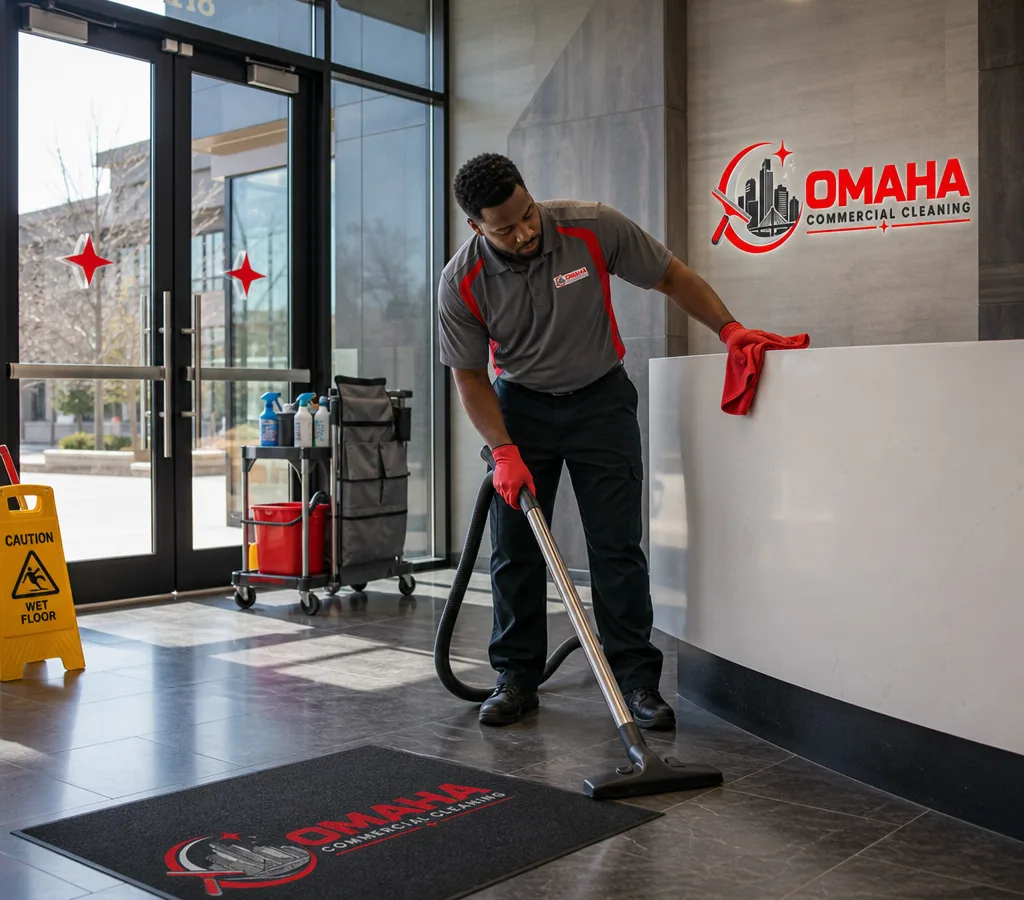
Strip and wax, burnishing, carpet extraction, tile and grout restoration, matched to the surface you actually have.
Floors are the most expensive surface in most commercial buildings and the easiest to damage with the wrong approach. A high-pH stripper on unsealed concrete, an aggressive pad on luxury vinyl tile, or hot extraction on a glue-down carpet with a failing adhesive can each turn routine maintenance into a replacement quote. Floor care in Omaha is worth treating as a specialty rather than an add-on to nightly cleaning.
The other half of the problem is timing. Floor finish does not fail suddenly, it wears through in traffic lanes while the rest of the floor still looks acceptable. Once the finish is gone and the tile itself is being abraded, restoration costs several times what maintenance would have. Buildings that scrub and recoat on a schedule almost never face a full strip.
Omaha's climate makes this sharper than in milder cities. Ice melt tracked in from November through March leaves a salt film that dulls finish and, left alone through the season, etches into it. Spring is when we see the damage from a winter of skipped entry maintenance.
Full removal of old finish, neutralising, then four to six coats of commercial floor finish with proper cure time between coats. This is the reset when finish has worn through or yellowed past recovery.
A lighter service that removes the top worn layers and adds fresh coats. Done on schedule it prevents full strips entirely, at a fraction of the cost and downtime.
Restores gloss between recoats and hardens the finish surface. Regular burnishing extends the life of a finish considerably in lobbies and corridors.
Deep extraction that pulls soil out of the pile rather than redistributing it, with pre-treatment on traffic lanes and spot work on stains before the main pass.
Pressurised cleaning that lifts soil out of grout lines, with optional sealing afterwards. Restrooms and kitchens are where the difference is most visible.
Warehouse and showroom concrete cleaned, densified and sealed, or polished for a finished look that stands up to forklift and cart traffic.
Getting this wrong is expensive, so it is worth knowing what you have before anyone brings a machine into the building.
VCT (vinyl composition tile): The classic wax-and-buff floor found in schools, clinics and older offices. Handles stripping well and needs finish to survive. Most VCT problems come from too few coats or skipped recoats.
LVT and luxury vinyl plank: Frequently mistaken for VCT and treated the same way, which ruins it. Most LVT has a factory wear layer that should not be stripped or aggressively burnished. It needs neutral cleaners and gentle pads.
Ceramic and porcelain tile: The tile is durable, the grout is not. Grout is porous and holds soil, so restoration focuses on the lines rather than the tile face. Sealing afterwards buys a long delay before the next deep clean.
Commercial carpet and carpet tile: Needs extraction on a schedule and prompt spot work. Traffic lanes wear from grit, not stains, which is why entry matting and vacuuming matter more than any single deep clean.
Sealed and polished concrete: Tough but not indifferent. Acidic or high-pH cleaners damage sealers, and polished concrete loses clarity without regular neutral-pH maintenance.
Natural stone, terrazzo and epoxy: Each needs specific chemistry. Stone is acid-sensitive, terrazzo has its own polishing sequence, and epoxy coatings can haze under the wrong product. We identify the surface before proposing anything.
Strip and wax in Omaha typically runs about $0.35 to $0.75 per square foot depending on the number of coats, furniture moving and how much old finish must come off. Scrub and recoat is usually $0.18 to $0.35. Carpet extraction commonly falls between $0.15 and $0.35 per square foot, and tile and grout restoration between $0.60 and $1.25 depending on grout condition.
Access and timing shift these numbers. Work that must happen overnight or across a weekend, in occupied buildings with furniture to move, costs more than an empty floor with open access. Heavily neglected floors also take longer, which is the practical argument for a maintenance schedule rather than emergency restoration.
We identify the actual surface, test a small area where needed, and check finish thickness and wear. This step is where the wrong-method mistakes get prevented.
You get the method, product, number of coats, cure times and the realistic downtime window. Floor work is disruptive, so scheduling is discussed rather than assumed.
Furniture moved or worked around by agreement, signage placed, and areas sectioned so parts of the building stay usable where possible.
The most common failure in floor work is rushing cure time between coats. Finish that is walked on early never reaches full hardness and wears out early.
We review the finished work with you and set the recoat or extraction interval, so the next service happens before the floor needs rescuing.
Most Omaha commercial floors need a full strip every twelve to twenty-four months, with scrub and recoat every three to six months in between. Buildings that keep up with recoating often go several years without a full strip. Traffic volume and entry matting matter more than the calendar.
Finish is walkable roughly one to two hours after the final coat, but full cure takes twenty-four to seventy-two hours. Rolling loads, carts and furniture should stay off for at least a day. We schedule around weekends where possible for this reason.
Some, not all. Soil-based marks usually respond well. Dye stains, bleach damage and stains previously treated with the wrong product may be permanent. We tell you before starting which marks are likely to lift, rather than after.
We can, and it changes the price and the schedule. Many clients move desks and light items themselves and have us handle heavy fixtures. Whichever way it is decided, it goes in the written scope so nobody is standing around waiting.
It is worth knowing, because the maintenance is different. LVT usually has a printed pattern with an embossed wear layer and joins that click or glue as planks. VCT is normally uniform 12 by 12 inch tiles with color through the thickness. We check during the assessment, since treating LVT like VCT damages it.
Sections can be done in occupied buildings using barriers and signage, and that works for corridors and smaller areas. Full strip and wax realistically needs the space empty, which usually means an evening, a weekend or a holiday closure.
Ongoing janitorial contracts with an assigned crew, a written scope and managed supplies, so your…
Cleaning built around how offices actually run, from desk surfaces and conference rooms to the breakroom…
A detailed reset that reaches what routine cleaning does not: vents, baseboards, high dusting, appliance…
Three-phase construction cleanup that takes a finished build from dust and debris to handover condition.
Interior and exterior commercial glass on a schedule that keeps storefronts and offices looking…
Cleaning built for industrial floor plates: ride-on scrubbing, high bay dusting, dock areas and…
Scheduled janitorial service for offices, retail and facilities across Omaha…
Kitchen, dining room and back-of-house cleaning scheduled after close, built around health inspection…
Building-wide cleaning for property managers: lobbies, corridors, elevators, stairwells and tenant…
Cleaning for clinics, dental and specialty practices with documented disinfection protocols and correct…
Store and shopping center cleaning timed around trading hours, focused on entries, sales floors and the…
Tell us the surface type and square footage, or let us identify it during a walkthrough. We will assess condition and propose a plan that fits your building's traffic.